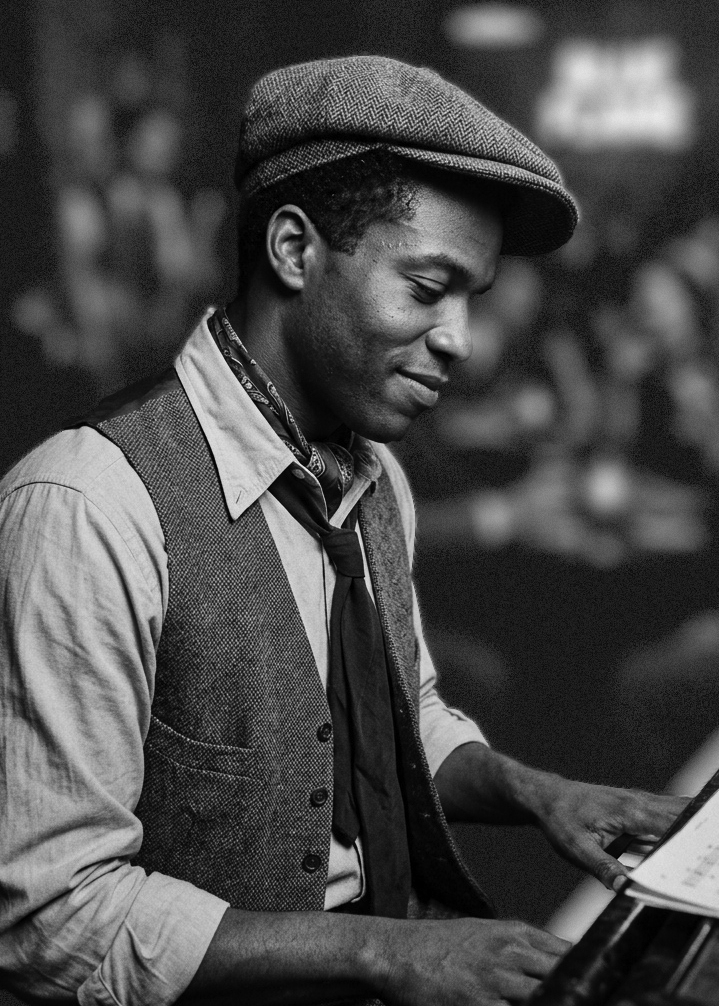
A New Stage Play · Revision 6, April 2026 · Written by Daniel Pettus
Seven professors. A nightclub singer. Nine years of the wrong kind of listening.
A full-length stage comedy. Based on the 1948 Samuel Goldwyn film directed by Howard Hawks, from a story by Billy Wilder.
"The play moves with the propulsive logic of a jazz performance: theme, variation, development, resolution."
— from the production notesIn a grand Upper West Side research library in 1948, seven professors have spent nine years compiling the world's most ambitious encyclopedia of music. They know every date, every tempo, every published fact about American music. They have never once listened to it.
Professor Hobart Frisbee leads the Totten Foundation's jazz encyclopedia with the devotion of a man who has confused thoroughness with understanding. Then Honey Swanson arrives.
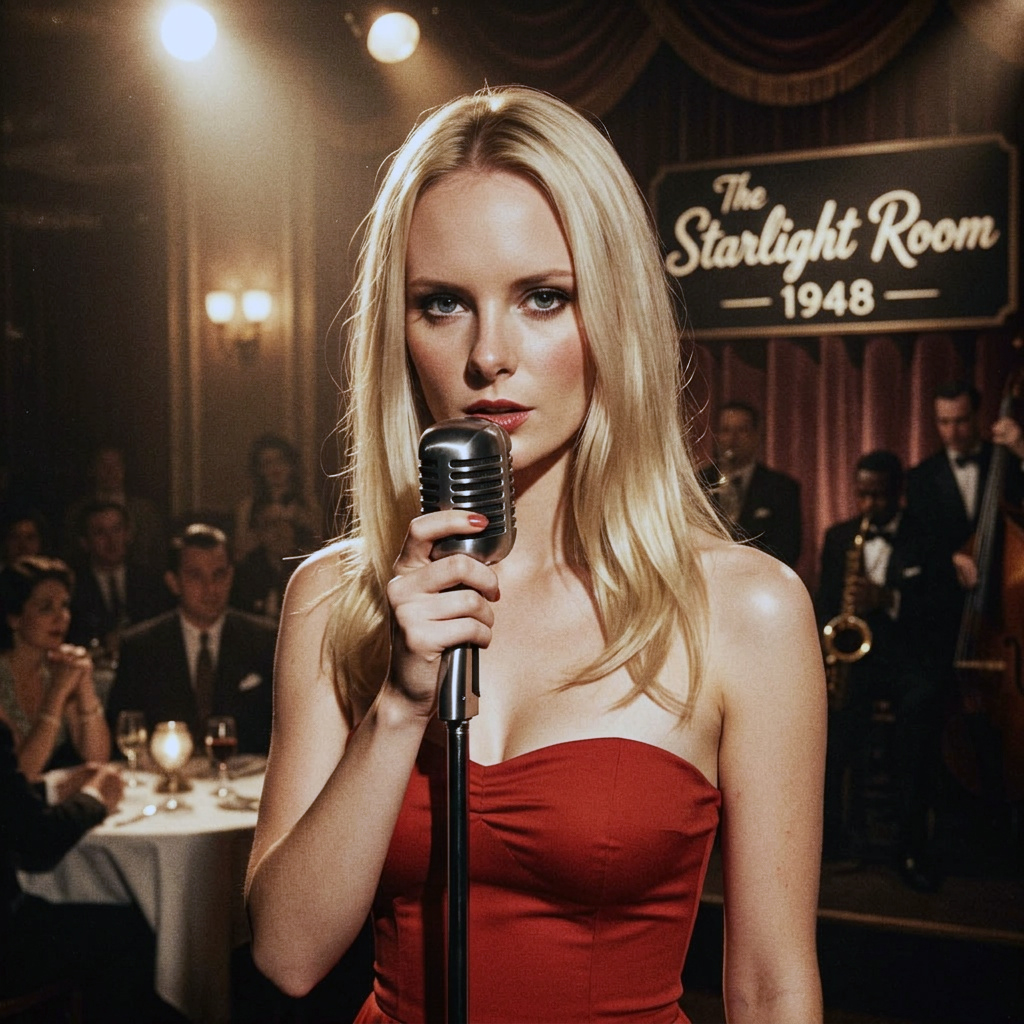
She is a nightclub singer, streetwise and quick, running from a gangster who would prefer she not testify against him. She needs somewhere to disappear. The Foundation, with its seven unworldly scholars and its limitless capacity for not noticing things, is the most invisible place in New York.
What follows is two days that change everything — for the professors, for Honey, and for anyone who has ever believed that knowing something and understanding it were the same thing.
The music is not accompaniment. It is character: every one of the ensemble's sixteen cues a voice in the scene, never background. The play's climax, built around three appearances of Flying Home (Hampton/Goodman, 1939), asks what it means to truly hear something — the first time as revelation, the second as battle, the third as joy.
A play about the distance between knowing something and understanding it. And, underneath, a love story: the two days it takes a man and a woman to cross a room.
Nine years at this table. Nine years of my life. Do you know what I might have accomplished in nine years?
— A different encyclopedia?
…That's almost certainly it.
Professors Gench & Elkon · Scene One
That note you bent in the second chorus — the way you let it fall rather than resolve — do you know that technique traces directly back to —
West African vocal tradition?
You know music theory?
I know music. Theory came later.
Hobart & Honey · Scene Four
Note for the encyclopedia: Jazz is not a subject.
Jazz is a verb.
Professor Elkon · Scene Sixteen
The 1948 Samuel Goldwyn film — directed by Howard Hawks, from a story by Billy Wilder — gathered six legends of American music onto a single soundstage in an act of artistic generosity that was unrepeatable then and is unimaginable now.
This stage adaptation honors that legacy while doing something the film could never do: let the music be live, unrecorded, and present in the room.
A camera can capture a performance. A stage places you inside one. The ensemble is never in the wings, never pre-recorded, never incidental. They watch the action. They respond to it. When the play is funny, they swing. When it aches, they slow. They are a chorus, a conscience, and a punctuation mark.
The music should never sound like a museum piece.
It should sound like something happening right now.
"This is not a museum piece. It is a new play, built for a live room, about what happens when people stop organizing knowledge and start listening."— from the Production Notes
Daniel Pettus
Playwright
There is no agent. There are no prior productions. What there is: a writer who spent thirty-five years solving a specific problem — the gap between data collected and knowledge felt — in a field that had nothing to do with theater.
Vice President roles at Becton Dickinson and CareFusion. A $2 billion portfolio in medication management and EHR integration. Patents in medical device connectivity. Published in IEEE, the Journal of Clinical Monitoring, and BI&T, where his 2014 article on infusion pump integration won Best Article of the Year. Recognized publicly by Yale University and UC San Diego for contributions to anesthesia informatics and patient safety.
And then: a 1948 Howard Hawks film, watched once, then again, then again. A question that would not let go: what would this story be if the music were live, unrecorded, and present in the room?
That is either a very bad sign for a playwright, or a very interesting one.
We believe it is the latter.
He came to this material by an unconventional route. He believes — and the work bears out — that this is precisely why the play is what it is. A Song Is Born is his first play. The script is complete. The voice is entirely his own.
Complete production documentation available on request. The script is ready for the room.
A Song Is Born, Revision 6 — April 13, 2026. One act, sixteen scenes, approximately 1 hour 45 minutes. Complete with character descriptions, setting notes, all stage directions, and production notes from the playwright.
Complete staging documentation for proscenium production. Permanent zone maps, scene-by-scene blocking guidance, lighting specifications, transition timing, prop lists, and acoustic considerations for the live ensemble.
Scenes One and Two of the script — the full opening sequence that establishes world, voice, and dramatic problem. The music enters on the second page. Read it here, in the browser. No download required.
"The jazz ensemble should be treated as a full creative collaborator in production. The musical director should be given latitude to expand, develop, and improvise within the framework provided."
— Production Notes, On the MusicThe script is complete. The production package is ready. There is no development left to do before a reading, a workshop, or a full production. This play can be scheduled, cast, and rehearsed right now.
If A Song Is Born is something you'd like to read — or if you've already read it and want to continue the conversation — Daniel would like to hear from you.
Not through a submission portal. Not a cold query letter. A conversation.
No submission queue · No agent required · Just a note
"Jazz was built on exactly this: people believing in something before it was finished. Backing it with what they had. Showing up to the session not knowing quite what would come out, but knowing it was worth the room."
— from the Playwright's Note
From Revision 6 · April 13, 2026 · Written for the Stage by Daniel Pettus
Lights rise slowly on the TOTTEN FOUNDATION. Morning. Dust motes in the light. The MUSICIANS are already present in their corner, instruments at rest but ready, watching the room with the patient intelligence of people who understand that everything eventually becomes music.
Seven professors occupy the research table in various attitudes of scholarly exhaustion. PROFESSOR ODDLY eats a sandwich. PROFESSOR TWEED paces in a small, anxious circuit. PROFESSOR GENCH stares at the ceiling. PROFESSOR MAGENBRUCH has his ear trumpet aimed at the window. PROFESSOR ELKON sharpens pencils. PROFESSOR SIGGY stands at the window with his hand pressed to his chest as though preventing his heart from escaping. At the head of the table, surrounded by the highest mountain of papers, PROFESSOR HOBART FRISBEE writes with ferocious concentration, his glasses at the very end of his nose.
This is nine years. It looks like nine years.
Oddly
(between bites)
Hobart. Stephen Foster. Beautiful Dreamer. Year?
Hobart
(not looking up)
1864. Published posthumously.
Oddly
Waltz?
Hobart
Three-four time. Parlor song. Please, Oddly.
Silence. Pencils scratch.
Gench
(to no one in particular)
Nine years.
Tweed
I'm sorry?
Gench
Nine years at this table. Nine years of my life.
Do you know what I might have accomplished in nine years?
Elkon
A different encyclopedia?
Gench
(considers this)
— That's almost certainly it.
Siggy
(turning dramatically from the window)
Do you hear that, gentlemen?
Silence.
Tweed
I don't —
Siggy
Precisely. The silence of great minds at work.
It is almost music in itself.
Magenbruch
(loudly, having heard nothing)
What? Is someone talking about a recital?
Everyone
No, Magenbruch.
Magenbruch
Pity.
The door opens. MISS BRAGG enters with a tea tray, moving with the authority of someone who views domestic service as a form of moral enforcement.
Miss Bragg
Tea.
(Sets it down. The clatter makes everyone flinch.)
I'll also remind you that Miss Totten arrives at eleven with her attorney,
and I expect this room to look less like a paper mill after a tornado.
Hobart
Thank you, Miss Bragg.
Miss Bragg
(noticing)
Professor Oddly. Is that a sandwich?
Oddly
It's quite small —
Miss Bragg
This is a research library. Not a delicatessen.
She exits. A beat.
Gench
She's right about Miss Totten, you know.
Something's wrong. You don't bring a lawyer to say everything's fine.
Hobart
(still writing)
I'm sure it's a routine visit.
Gench
(producing a crumpled invoice from his coat)
Has she seen last spring's expenditures?
The room goes quiet. The other professors become very interested in their papers.
Hobart
(slowly putting down his pen)
What expenditures from last spring?
Siggy
Supplemental research materials.
Tweed
Instruments, strictly for — for —
Oddly
The tuba was academic.
Hobart
We already have a tuba.
Oddly
A baritone tuba. This was a contrabass. Entirely different animal.
Hobart takes the invoice. Reads it. His eyebrows rise with the slow inevitability of bread.
Hobart
Gentlemen. This is more than our entire previous year's allocation.
Gench
I know.
Hobart
When Miss Totten arrives —
I do the talking.
All of you look scholarly.
Look nearly finished.
Gench
We're not nearly —
Hobart
Look like it.
The MUSICIANS play a low, ominous little phrase. The professors return to their work.
The lights shift only slightly — it is still the Foundation, but time has moved. The table has been incompetently tidied. MISS TOTTEN sweeps in with MR. WARREN at her heel. She is sixty, impeccably dressed, and carries herself like someone who has never needed a second opinion. She scans the room, and her gaze lands on Hobart.
Miss Totten
Hobart.
Hobart
(standing, toppling one stack of papers)
Miss Totten! What a pleasure. You look — that is — welcome.
Welcome to the Foundation.
Miss Totten
(warmly)
You say that every time, dear.
Warren
(opening his briefcase)
Shall we come to the matter at hand —
Miss Totten
We shall come to nothing until everyone is seated, Mr. Warren.
Sit down, please.
They sit. Warren lays out documents with the efficiency of a man delivering a verdict.
Warren
Professor Frisbee.
The original grant was intended to produce a completed encyclopedia within five years.
You are in year nine.
Our accountants project the work will be completed —
(checking notes)
— never.
Gench
(under his breath)
There it is.
Warren
Miss Totten is therefore considering withdrawing her sponsorship entirely
and redirecting her resources toward the Totten Memorial Concert Hall.
The professors look stricken. Oddly's sandwich lowers.
Hobart
(carefully)
Miss Totten. I won't pretend the project hasn't taken longer than we anticipated.
— end of excerpt —
The full script continues for fourteen more scenes.